The authority to site and permit high-voltage transmission lines has historically rested with the states.  However, the federal government has been trying to wrest this authority from the states for years.

The states consider local need and issues when evaluating a project.  Affected stakeholders are afforded due process to participate in the debate at the state level.  Occasionally, a state will deny an application for a transmission project that provides no benefit to the state.  The feds, and the investor owned utilities who relentlessly lobby them, want to remove consideration of new transmission projects to Washington, DC, where due process will be smothered by national policy goals. 

But it hasn't been smooth sailing for the feds.  Congress has repeatedly declined to federalize transmission permitting and siting, preferring to leave authority with the states.  But the feds and the utility lobbyists have found other ways to try to gain what they haven't been granted by Congress. 

The Energy Policy Act of 2005 hid a few little wormholes for the feds to override states and claim eminent domain to site transmission under certain conditions.  One was Section 1221, the creation of National Interest Electric Transmission Corridors and backstop siting authority for FERC to site transmission in these corridors in the event a state failed to act.  That section has been neutralized by the courts.

But, a second federal eminent domain tool that has not yet attracted much attention is about to be deployed through Section 1222, Third-Party Finance, in order to execute one of the worse abuses of federal eminent domain authority in history.  Section 1222 provides:
The Secretary, acting through WAPA or SWPA, or both, may design, develop, construct, operate, maintain, or own, or participate with other entities in designing, developing, constructing, operating, maintaining, or owning, a new electric power transmission facility and related facilities (“Project”) located within any State in which WAPA or SWPA operates if the Secretary, in consultation with the applicable Administrator, determines that the proposed Project--
(1)(A) is located in an area designated under section 216(a) of the Federal Power Act [16 U.S.C. 824p(a)] and will reduce congestion of electric transmission in interstate commerce; or
(B) is necessary to accommodate an actual or projected increase in demand for electric transmission capacity;
(2) is consistent with--
(A) transmission needs identified, in a transmission expansion plan or otherwise, by the appropriate Transmission Organization (as defined in the Federal Power Act [16 U.S.C. 791a et seq.]) if any, or approved regional reliability organization; and
(B) efficient and reliable operation of the transmission grid;
(3) will be operated in conformance with prudent utility practice;
(4) will be operated by, or in conformance with the rules of, the appropriate (A) Transmission Organization, if any, or (B) if such an organization does not exist, regional reliability organization; and
(5) will not duplicate the functions of existing transmission facilities or proposed facilities which are the subject of ongoing or approved siting and related permitting proceedings.
WAPA and SWPA are federal power marketing agencies set up to sell and deliver hydropower across central, western and southern states.  WAPA and SWPA, as federal agencies, are endowed with federal eminent domain authority to take private property for use in their systems.  Doesn't sound so bad, does it?  However, Section 1222 allows the Secretary of Energy to utilize WAPA's & SWPA's eminent domain authority for benefit of third-party projects in the agencies' territories that are not connected or necessary to their systems.  And this is where the slippery slope starts, friends.  Congress tried to prevent this kind of bad behavior by including qualifying standards for third-party projects, such as being approved in a regional transmission plan or equivalent, which would prevent duplication of projects, and requiring a finding of increased demand necessitating such a project.  Congress also put a cap on the amount of money WAPA and SWPA could accept from third parties.
(g) Maximum funding amount
The Secretary shall not accept and use more than $100,000,000 under subsection (c)(1) for the period encompassing fiscal years 2006 through 2015.
And Congress also stipulated that Section 1222 could not override existing state laws.
d) Relationship to other laws
Nothing in this section affects any requirement of--
(1) any Federal environmental law, including the National Environmental Policy Act of 1969 (42 U.S.C. 4321 et seq.);
(2) any Federal or State law relating to the siting of energy facilities; or
(3) any existing authorizing statutes.
But, personal relationships between DOE personnel and leadership of a private, for-profit corporation made things just so cozy that an RFP for Sec. 1222 projects was issued in 2010 that coincided with the development of this company's long-haul HVDC projects. 
Jimmy Glotfelty – Executive Vice President of Clean Line Energy Partners
Mr. Glotfelty brings a wealth of public and private sector transmission experience to Clean Line. He is a well-known expert in electric transmission and distribution, generation, energy policy and energy
security. He most recently held the position of Vice President, Energy Markets, for ICF Consulting. Mr. Glotfelty served in the US Department of Energy where he was the Founder and Director of the Office
of Electric Transmission and Distribution, a $100 million per year electricity transmission and distribution research and development program
. Mr. Glotfelty also was the lead US representative to
the joint US-Canadian Power System Outage Task Force investigating the Blackout of August 2003.
While at the Department of Energy, Mr. Glotfelty worked extensively with utility chief executive officers and senior management in the electric power and energy sectors. He led teams that focused on researching transmission and distribution technologies, gaining Presidential permits for cross-border transmission lines, studying the impacts of Regional Transmission  Organizations, identifying major transmission bottlenecks, and securing the critical energy infrastructure of the United States.
And the next thing you know, Clean Line Energy Partners became the first and only transmission developer to respond to DOE's RFP for third-party financed projects under Sec. 1222.  Clean Line submitted a voluminous application for its Plains & Eastern Clean Line merchant transmission project in July 2010.  In its application, Clean Line made it clear that its only interest in participating under Sec. 1222 was the ability to have SWPA condemn land for its project:
DOE and Southwestern understand and agree that their ability to acquire through condemnation proceedings property necessary for the development,  construction and operation of the Project is one of the primary reasons for Clean Line’s interest in developing the Project with DOE and Southwestern and through the use of EPAct 2005 section 1222.
DOE and Southwestern agree that, if the Secretary of Energy ultimately decides upon the conclusion of such evaluation as DOE and Southwestern deem appropriate that (i) the Project complies with section 1222, and (ii) to participate in the Project’s development pursuant to section 1222, then, DOE and Southwestern will use their condemnation authority as may be necessary and appropriate for the timely, cost-effective and commercially reasonable development, construction and operation of the Project.
Clean Line Energy Partners is a privately held company owned by Michael Zilkha and ZAM Ventures that is proposing to build four HVDC merchant transmission projects originating in the midwest.  A merchant transmission project is a for-profit venture that is paid for entirely by its owner.  In exchange for investing billions, Clean Line's super-rich owners will earn a hefty return on their capital by selling transmission capacity on the transmission lines to both generators and load serving entities.  Merchant transmission projects are speculative ventures that are proposed and built outside the regulated regional transmission planning process.  Merchant lines proposed outside a planning process have not been determined to be needed by anyone other than their owners.  If a transmission project is needed for reliability, economic or public policy reasons, it is approved by and included in the plan of a regional transmission operator.  A merchant transmission project is the wildcatter of the transmission business.

Without Section 1222 and SWPA's ability to take land for Clean Line via eminent domain, the company would have to apply for and receive public utility status and the power to condemn private property for its private gain from each individual state that it crosses.  This could prove onerous to the super-rich and muck up or delay their profit.

In exchange for stealing private property from citizens to be used for a private company's gain, SWPA could be granted a certain amount of transmission capacity on Clean Line's project, however, SWPA isn't in the wind business.  But DOE can use authority it was granted under Sec. 1222 to pick winners and losers in the renewable energy business, and Clean Line's investors put together a team with strong DOE connections.  Coincidence?  Probably not.

So, does Clean Line's project meet the requirements of Sec. 1222?

(1)(A) is located in an area designated under section 216(a) of the Federal Power Act [16 U.S.C. 824p(a)] and will reduce congestion of electric transmission in interstate commerce; or
(B) is necessary to accommodate an actual or projected increase in demand for electric transmission capacity;


Sec. 216(a) has been nullified by the courts, so (A) isn't even an option.  Here's Clean Line's justification for qualifying for (B) from their application: 

"In addition to the general demand for more transmission oriented to renewables, there is and will be a specific demand for transmission to address the following concerns:
Additional Transmission is Needed to Develop Wind Resources in the Southwest Power Pool;
Additional Transmission is Needed to Relieve Congestion in Western SPP;
Additional Export Capability is Needed from SPP; and
Additional Transmission is Needed to Import Power in the Southeast.
The Plains & Eastern Clean Line meets each of these needs."


No actual projected demand for the project from any official authority tasked with determining same was included.  The company points to bits and pieces of out-of-date studies that it feels justifies its desire to build this project, along with studies privately commissioned by the company.  I don't think this is the kind of "actual or projected increase in demand" that Congress had in mind.  It's pure posturing of the worst kind.

Other requirements stipulate that the project:

(2) is consistent with--
(A) transmission needs identified, in a transmission expansion plan or otherwise, by the appropriate Transmission Organization (as defined in the Federal Power Act [16 U.S.C. 791a et seq.]) if any, or approved regional reliability organization; and (5) will not duplicate the functions of existing transmission facilities or proposed facilities which are the subject of ongoing or approved siting and related permitting proceedings.


Clean Line's idea of compliance with this requirement?

"SPP repeatedly has identified the need to build additional transmission to fully develop wind potential in
the region and to export it to neighboring regions."
  Right, but SPP did not identify Clean Line as the solution in its transmission expansion plan, or otherwise determine its project was needed.

Clean Line also relies on:

"The Plains & Eastern Clean Line is consistent with transmission needs identified in the Joint Coordinated
System Plan 2008 (JCSP). The JCSP was the first inter-regional transmission planning effort in the
Eastern Interconnection. The JCSP was a collaborative effort and involved most of the major
transmission operators in the Eastern Interconnection, including, MISO, SPP, PJM Interconnection, TVA,
Mid-Continent Area Power Pool and several key members of SERC."


And this 5 year old plan has been scrapped.  Also not what Congress had in mind for this requirement.

When DOE questioned Clean Line's eligibility under Sec. 1222, the company submitted an "updated application" that contained the same old lack of convincing evidence of qualification.

Nevertheless, DOE issued a letter entering into an agreement with Clean Line to move forward with the NEPA process.  DOE has not completely committed to the project yet, but if it does:

  • Clean Line will agree that eminent domain authority would be used only as a last resort after negotiations in good faith have concluded with all affected landowners;
  • Clean Line will agree that the Department will retain the option to select and oversee any land acquisition company required for the Project.
In that case, DOE needs to take a look at the complete and utter mess Clean Line has made out of the public information and land acquisition process.  Clean Line's idea of good faith negotiations with landowners, according to its updated application, put landowner notification last.  Clean Line makes much of meeting with "stakeholders" such as environmental organizations, state agencies, state legislators, members of the governors’ teams, and federal congressional delegations.  But only after all these entities, who are not personally affected and will not have to live with a Clean Line in their own backyard, have drunk the Clean Line Koolaid, does Clean Line consult with landowners:

"After the workshops, Clean Line will host public
open houses to gather feedback on the preferred and alternative routes from landowners and other
affected parties. These outreach efforts are designed to assure that relevant stakeholders have early and multiple opportunities to provide feedback..." 
except for landowners.  Landowners are not considered "relevant stakeholders" by Clean Line.

DOE should think long and hard about making the federal government liable for the legal mistakes of a private company.  Just because the feds were successful in asserting federal eminent domain in another dissimilar situation, does not mean that helping the rich get even richer at the expense of the common man is a good idea.  How much money does Congress have budgeted for another federal court beatdown over eminent domain takings?

And DOE needs to take a good, hard, objective look at Clean Line's "qualifications" under Sec. 1222.  The company doesn't qualify without torturing the language in the statute, and a finding that it does qualify is also likely to lead to a separate, but equally vicious, court showdown.

Sometimes, it's just not worth the risk to help your "friends" by overstepping your legal authority and bending federal law.  Maybe the incoming Energy Secretary needs to do a little housekeeping before Congress does it for him, or he finds himself explaining DOE's taking of ordinary citizens' private property for use by super-rich investors.  Congress has resolutely rejected federal transmission siting authority over and over again and will likely continue to do so.


It seems that citizen opposition to its "Clean" Line projects is increasing!

"Clean" Line tried the "I elect transmission lines to public office" strategy by schmoozing and making empty promises to businesses, legislators, local governments and other groups long before the affected landowners who would have to sacrifice their land for this project got wind of it.

How effective was "Clean" Line's "community consultation" when the ones most affected by its projects were never consulted?

Approaching a community with a front-loaded fait accompli is a big, bad no-no.  Tsk, tsk, tsk, "Clean" Line!

Also, the political strategy playbook has been outed, studied and neutralized by transmission opponents.  How effective is a "playbook" when the other team has a copy, "Clean" Line?

Introducing -- Block Grain Belt Express!

Now affected communities in Kansas, Missouri and Illinois have their own sister group to the original Block Rock Island Clean Line.

Coming soon...  even more opposition!

Nobody needs or wants your "clean" projects, arrogant Texas and New York entrepreneurs.  Go wreck your own backyards in your own states.  Fail!
 
 
Holy plagiarism, Batman!  I ended up with a copy of Grain Belt Express Clean Line's "Code of Conduct" for Right-of-Way Agents and Subcontractors in my email today.

This silly document is nothing but window dressing masquerading as "proof" that Clean Line's land sharks are following some sort of moral compass.  This document does nothing to stop land shark abuse of landowners.  Who's supposed to enforce it?  Nobody!  What are the penalties or legal remedies for violation?  There aren't any!  It's your word against theirs.

This document has an interesting history.  Notice how it's written to supposedly prohibit certain behaviors?  Does the specificity of certain tactics seem a bit odd to you?  That's because each one of these land agent no-nos was a tactic actually perpetrated on landowners in Pennsylvania by land agents for TrAILCo.  This "Code of Conduct" came into existence through a court battle fought by the Pennsylvania Office of the Consumer Advocate, who is tasked with representing the interests of consumers, who had been victim to these very same land agent tactics.  In its original form, it was enforceable by the Pennsylvania authorities.  In its current incarnation, it's not worth the paper it's printed on.  It's mere suggestion that is more for the landowner's benefit as an imaginary security blanket than it is a set of rules for Clean Line's land sharks.

The "Code" was re-used by TrAILCo's parent company for their subsequent PATH project.  Turned out that the West Virginia PSC wasn't interested in enforcing it, therefore, the document was worthless.  PATH land sharks violated it constantly, according to affected landowners.

And now Clean Line has plagiarized this document from PATH, thinking it will fool a whole new crop of rubes in the midwest.  Not.  It's even complete with the same PATH-created typos... what a bunch of idiots you are, Clean Line!!

So, what's your best defense?  Refuse to speak or interact with Clean Line land sharks without the assistance of your attorney and insist that all conversations be recorded.  You'll still have to pursue any "violations" through civil court, but I have a feeling the land sharks won't be so willing to star in your own personal video production and will avoid you and your camera or tape recorder like a.... plague of bolt weevils, perhaps?
 
 
It looks like Clean Line Energy Partners' opposition denial honeymoon is so o-ver!

In addition to the active and vocal BlockRICL opposition that has been giving the Rock Island Clean Line headaches in the states of Illinois and Iowa, now citizens of other Midwestern states, like Oklahoma, Kansas and Missouri, are questioning the Grain Belt Express and Plains & Eastern Clean Line projects and beginning to organize to oppose those projects.

Silly Clean Line, you can't build a transmission line without opposition.  It's not about whether the transmission line is transporting "clean" or "dirty" energy, it's about need for the transmission line.  Affected landowners will always question the determination of need for a new transmission line.  And what does Clean Line have?  "Wind" energy must be transported to east coast states so that wind developers in Kansas, Oklahoma and Iowa can get rich?  Its not about farmers or landowners cashing in, it's all about private, for-profit corporations and their investors making a whole bunch of money off the backs of what they arrogantly consider to be uneducated rube farmers and environmentally conscious but sadly oblivious east coast consumers who are easily fooled by the green-washing Midwest "wind" scheme.

Let's examine some of the propaganda and empty promises Clean Line is utilizing in a rather sad, transparent attempt to build false advocacy for its project with the hope that it will be enough to influence state siting approvals.

1.  Hold "open houses" for local businesses and "collect their information" and tell them they will be notified to bid on project supplies and labor when the time comes.  By making these kinds of empty promises to local businesses, Clean Line buys their support and advocacy for free!  By the time these local businesses realize that there's no role for them in building one of these "clean" lines, it's too late.  The Texas shysters will already have their state approval to take property by eminent domain and build their money-making transmission line with imported labor and supplies.  The fact is that building high voltage transmission is a highly specialized industry and labor will be imported for the duration.  The only "local" jobs may be a few fast food servers or motel housekeepers to serve these professional transmission builders for a few weeks while temporarily housed in your locality building the line.  Supplies and components will be contracted from a handful of large corporations, many of them manufactured in other countries.  If you don't believe me that Clean Line's promises to local businesses are empty, try getting Clean Line to sign a supply or labor contract with your local company today.

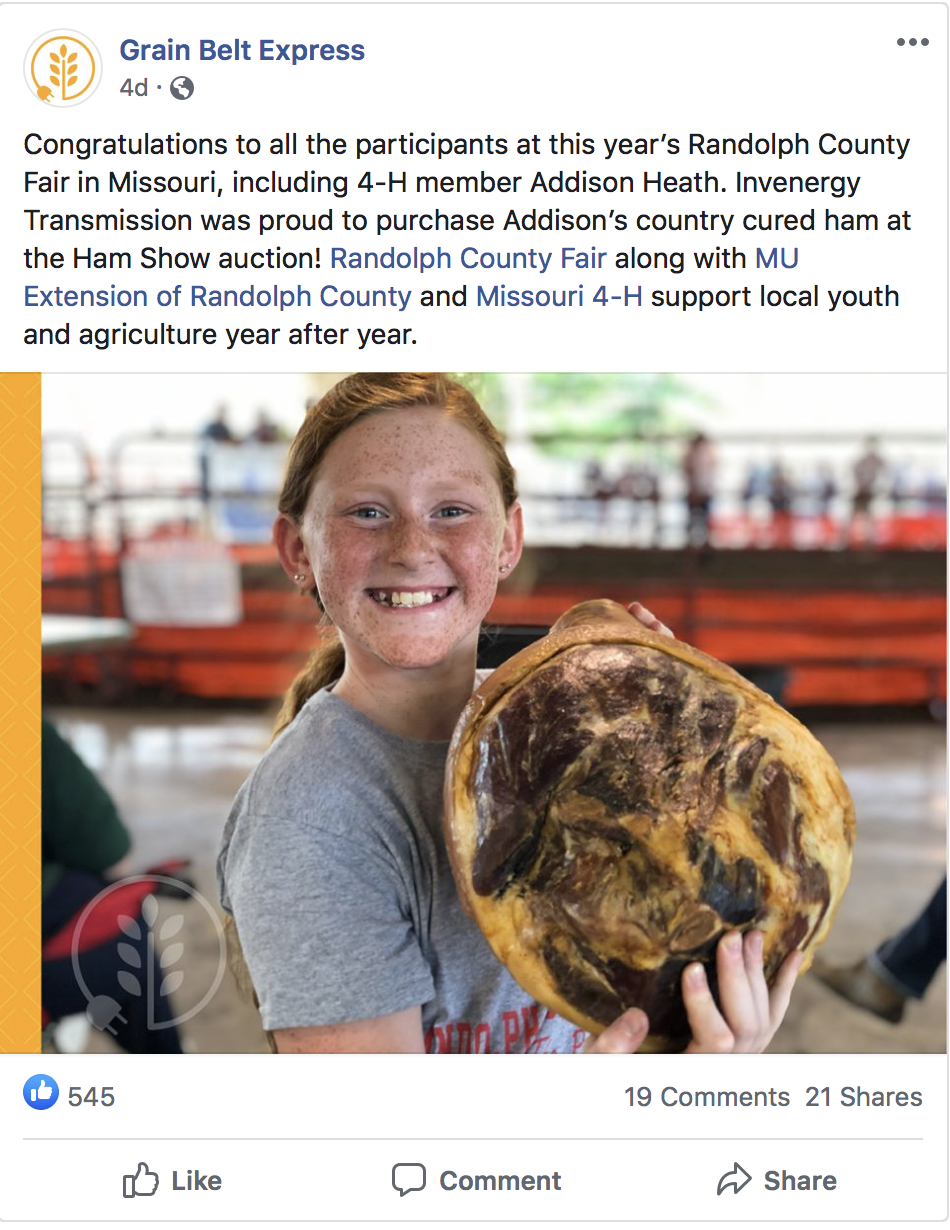
2.  Holding "open houses" for landowners and pretending that Clean Line is interested in answering questions and receiving information from affected landowners.  This is a ruse used by the company to evaluate the possibility of opposition and give the appearance of community consultation.  It is also set up to divide and conquer landowners individually by suggesting that cooperation could push the line over onto a neighbor's property *wink, nod.*  Landowners come away with more questions than answers, but most likely the magic has already happened, despite Clean Line's best obfuscating efforts.  The ones who will lead the opposition to the project have already self-selected and made important contacts with like-minded individuals over plates of free Clean Line ham.

"One landowner came with a plastic sack and took about a two-inch width of slices of ham. I looked at him and he said, 'I've got cats,' " Nelson said. "Everybody else was saying, 'We might as well eat. That might be all we get.' "

3.  Pretending that the transmission lines will carry 100% renewable energy desperately wanted and needed in east coast states and that the cost of the lines will not be end up in local electric bills.  These "clean" lines will also carry electricity generated by fossil fuels because the maximum capacity for a variable resource like wind is somewhere around 35%.  Also, federal regulations prohibit Clean Line from banning fossil-fuel generators from buying capacity on the line.  While Clean Line is telling the public that it is a merchant, or privately-financed, enterprise, Clean Line has asked federal regulators to approve broad socialization of merchant lines to those who do not consume the renewable electricity, claiming that new transmission lines create regional "reliability" benefits simply by existing.  If Clean Line and other "renewable" energy benefactors are successful in socializing the cost of their projects across entire regions, we're all going to be paying to transport renewable energy from coast to coast, whether we consume any of it or not.

4.  Bullying of landowners, consumers, citizens and government agencies by Clean Line personnel.  The prospect of a huge profit can make corporate lackeys do despicable things.  Compare this photo of Clean Line President Michael Smelly (in the cast - let's not even think about how that might have happened) "observing" the interaction between the public and federal environmental impact statement personnel during a public scoping meeting with these photos of PATH Transmission personnel "observing" the interaction between the public and federal environmental impact statement personnel during a public scoping meeting.  "Observation" easily degenerates into intimidation when things aren't going to the transmission line company's liking.  Don't be intimidated!

It's time for Texas-based, Wall Street-financed, Clean Line Energy Partners to quit denying its opposition, and come "clean" with the public.  Fact is, Clean Line is applying to states for the right to condemn right of way for its private, for-profit, project through eminent domain.  But, Clean Line hopes you rubes will be good sports and allow yourselves to be taken advantage of by its hired, professional land sharks, err, I mean "land agents," and sell your land early and cheaply.  Don't be foolish, always seek your own legal counsel before signing any agreements.  Your attorney will tell you that the longer you resist land sharks, oops, I mean "agents," the higher the price of your land climbs.  Land owners who resist eminent domain grabs receive, on average, 5 to 6 times the original offer by holding out and settling on the court house steps just before a hearing.

And while you're holding out, you might as well explore whether organized and intelligent opposition can halt the transmission project in its entirety.  Yes, it can.  We killed the PATH project.


Don't get me wrong, I like clean energy as much as the next guy.  However, I'm not expecting Midwest farmers and other electric consumers to sacrifice their land and their money to allow me the privilege of believing that I'm somehow helping the environment when I turn on my centrally generated "green" electricity.  Clean Line is nonsense.  If you want to help the environment, how about making your own personal sacrifice to supply your own, locally-generated renewable power, such as installing solar panels on your own roof?  It is not sustainable to destroy prime farmland to meet your own personal renewable goals. 

The east coast doesn't want or need Clean Line's overpriced "wind" power.  Just say no to Clean Line.

So, if you're asking yourself -- do we really need these "clean" lines for renewable energy (no!); is there other opposition to these projects that I can join (yes!); and can opposition cancel one of these projects (yes!!), you've come to the right place.

Get in touch with the folks at BlockRICL, or email us for more information.
 
 
What was it I said last week?  It's going to get worse, much worse?

Tammy "something extra" has now listed all but one of PATH's River's Edge properties in Loudoun County for sale.  Here's how much these deals will cost you, assuming PATH receives full list price for the properties (which is never going to happen).

PATH purchased this property in February 2009 for $689,000, 98% of Loudoun County's assessed fair market value at that time.  It's on sale today for only $630,000.

PATH purchased this property in April of 2009 for $418,000, 102% of Loudoun County's assessed fair market value at that time.  It's on sale today for only $400,000.

PATH purchased this property in April of 2009 for $910,000, 110% of Loudoun County's assessed fair market value at that time.  It's on sale today for only $735,900.

And the big, big loser is this property that PATH purchased in March 2009 for $1,175,000, 246% of Loudoun County's assessed fair market value at that time.  It's on sale today for only $459,000.

Looks like Loudoun County's assessor was a lot more accurate about fair market values than PATH's appraiser back in 2009.  But yet PATH expects ratepayers to pay the difference between purchase and sale price and make the company whole.  Right now, the difference between PATH's purchase prices in River's Edge and their current list prices amounts to $1,021,300.  That's over a million dollars that ratepayers stand to lose on PATH's unnecessary and premature "investment" in real estate, and there's still one PATH-owned River's Edge property that has yet to hit the market, for which PATH paid 123% of market value in 2009.  Ouchies, little ratepayers, ouchies!!!

Let's take a look back at PATH's antics in River's Edge.  Now PATH adds insult to injury of these homeowners and dumps a whole bunch of real estate in their neighborhood at bargain basement prices, which is going to have a significant effect on their own home value and equity.  PATH -- the gift that just keeps on giving.

And PATH is so not done yet... they've still got to unload those substation properties they purchased for millions more than fair market value.  Get out your wallet, little ratepayer...
 
 
PATH properties.... get yer PATH properties... in the market for some dirt-cheap but poorly maintained real estate, or maybe some completely useless land with a burned out trailer or falling down shack?  PATH's real estate agent can help you with that, and she "offers something extra!"  I can't imagine what that "something extra" might be, but I'm sorta frightened by the offer.

PATH went ahead and listed some of its property for sale, despite the Federal Energy Regulatory Commission's November 30, 2012 Order that set the disposal of property for hearing:

"Because PATH has not completed the sale and transfers of land and other assets, we cannot determine based on the record whether self-dealing or cross-subsidization will occur as a result of these future transfers to  affiliates, and whether the proposed prices for sales to third parties are reasonable. As part of the hearing and settlement proceedings, we therefore direct parties to consider the reasonableness of such transfers and sales, including whether future transfers and sales of real property should be reported in periodic reports that identify the parties, date and price of each transaction. Parties in the hearing and settlement proceedings may also consider whether the formula rate should be modified to include such information, which would allow review of the asset sales and transfers under the  formula rate annual update process."


So, how "reasonable" are PATH's "fair market value" sale prices compared to "fair market value" amounts PATH spent purchasing each property?

PATH purchased this property for $50,000 in April of 2010.  It's on sale today for only $9,000!

PATH purchased this property for $64,000 in April of 2009.  It's on sale today for only $12,000!

PATH purchased this property for $307,185 in March of 2009.  It's on sale today for only $229,900!

Let's add up the difference between PATH's purchase price and PATH's sale price, because that is the amount PATH wants YOU to pay for its little unnecessary and overly generous property buying spree:  $170,285!  Even if PATH sells these properties at list, that's how much of a loss PATH expects ratepayers to absorb for just these three properties.  And it's going to get worse, much worse.

Bargain basement prices for unneeded properties - get yer worthless PATH properties today - and if you find out what Tammy's "something extra" is, do let us know.
 
 
Check out what Bill Howley dug up over at The Power Line.  It seems that a WV landowner is annoyed at PATH and the developer he bought property from that, unbeknown to him, PATH was planning to plow right through it.  The developer claims that it was also unaware about PATH until after the sale.

PATH is represented by the odious and insufferable shysters from Jackson Kelly that were so much fun during the PATH CPCN case in West Virginia.  The sophomoric haranguing of opponents that floats Jackson Kelly schmuck Melick's boat comes through loud and clear.

Q.    Did -- did anybody at PATH try to force you to sell property to them at this time?
A.    No.
MR. BOWLES:    I'm going to object to the form of the question. What does "force" mean? It's not clear.
MR. MELICK:    That's an English word.
Q.    (By Mr. Melick) Did anybody -- if you don't understand the question, I'll -- I'll explain it to....

Honestly, what a dipstick.  But once you get over the vaudeville going on, reading PATH's feeble lies is interesting, in a train wreck sort of way.  For instance, the Melick-clown keeps trying to insist that had the developer properly recorded the subdivision with the county that PATH would have avoided crossing through a subdivision.  Hahahahahahahaaa!  I seem to remember PATH's original route marching through my own subdivision (properly recorded in 1981) with such severity that 16 out of 31 existing homes would have been gone.  And then there was PATH's arrogant assertion to the owners of  these homes, at their dog & pony show, that these homes in the way would simply be torn down and disposed of.  Way to go, fellas!  :-)

So what? Even if the developer didn't record the subdivision properly, it's not going to win PATH any brownie points.

If you're one of the thousands of landowners who still has PATH's "suspended" project looming over your property, this might be a case worth following.


Interesting hearing at the WV PSC on Friday.  TrAILCo produced several witnesses in their defense... all on the TrAILCo payroll.

Jay Ruberto lived up to his landowner-given nickname of Snidely Whiplash by stating that he was "very proud" of the job TrAILCo did.  He's "very proud" of the way he treated John & Janie Ives, whose lives were turned upside down by TrAILCo's shifty land agents and the deceitful way they were treated?  In that case, I hope some greedy corporation treats his own parents in kind.  Karma is a cruel task master.

When asked what lesson the company had learned from TrAILCo, he said it was to keep the same land agents as a point of contact for landowners throughout the project.  Problems arose because landowners didn't hear land agents correctly and none of the land agent promises were in writing.  "It has to be in writing," said Ruberto.  Take a lesson, landowners -- TrAILCo has admitted how it was that they fleeced people.  A series of different land agents making promises that are never put into writing on the purchase agreement isn't a mistake.  It's done on purpose.  It's no coincidence that a land agent in a Canadian transmission case got busted for doing exactly what was done to landowners during the TrAILCo project.  A series of shifty land agents lying to landowners is an industry-wide transmission siting "Best Practice."  I guess TrAILCo hasn't really learned any lesson at all... yet.  Perhaps the WV PSC will stand up for West Virginians and teach the out-of-state TrAILCo corporation that they can't treat people that way.

TrAILCo also produced a trio of goofy kids from construction contractors and subcontractors who looked guilty as hell while testifying that all the destruction was caused by loggers hired by individual landowners, and the individual landowners themselves.  Next time, TrAILCo needs to hire some mature managers that look like they actually have some experience and not a bunch of kids who look nervous and guilty and treat the whole thing like a big, ol' funny joke.

TrAILCo's expert witness was a botanist, not a forester,  who shared that his contract with TrAILCo to evaluate the destruction in the ROW came after the March hearings and was subject to conflict between himself and TrAILCo.  I wonder what was in that contract?  He also testified that all the damage was done by landowner-hired loggers, but admitted that all his knowledge of these phantom destructive loggers came from TrAILCo (the guilty, smirking kids).  It's no wonder Commissioner Palmer demanded that TrAILCo submit a document stating their proof of independent loggers causing destruction at each contested site along the ROW.

The complainants entered a stack of DEP violation notices of individual incidences of environmental destruction for the TrAILCo project.

We gave TrAILCo's drama-queen, jack-in-the-box lawyer a new name after watching him pop out of his seat like it was spring-loaded with annoying regularity to object to everything and anything.  Me-me-me-me-me-lick (because it's all about "me") actually whined that TrAILCo's previously supplied map indicating which portions of the ROW were cleared by TrAILCo vs. which portions were cleared by landowners might not be correct because it was "only concerned with the 8 original sites identified in the complaint."  So, did TrAILCo lie when they submitted it, or are they lying now?

The Commission gave TrAILCo 30 days to submit their "proof" that all the instances of destruction in the ROW were caused by these mysterious "others."  The complainants will then have another 20 days to submit their rebuttal (which me-me-me-me-me-lick objected to and lost).  Then the Commission will issue its decision in the case.

Meanwhile, TrAILCo had best get busy repairing all the damage they did to private property while they built their transmission line and quit whining about how much it's going to cost.  Maybe if they hadn't offered all those bribes, like the new "transmission headquarters" and donations to energy assistance programs, in order to get their project approved by the PSC in the first place, they wouldn't be so hideously over budget now.  What do they care anyhow?  The ratepayers are footing the bill for all of it, and TrAILCo makes a pile of profit in yearly returns on the money they have invested in the project.  As a ratepayer, I'd much rather see my money being spent to return the private land to its former state, instead of leaving a trail of destruction and angry landowners as a legacy.  But then again, I must have a different definition of "proud" than the shysters at TrAILCo.
 
 
Read this article in the Edmonton (Canada) Journal.  A third party land agent representing the Heartland Transmission Project was recorded by landowners saying that leaders had already made up their mind about the project and that it was "going ahead", despite the fact that hearings had not yet been held.  They were also told that if they didn't sign at that time, the monetary offer "wouldn't be available" after project approval.

In their defense, power company Altalink's engineer, Darin Watson, said he was "absolutely appalled" by the actions of the land agent.  He said the land agent in question was terminated and that an investigation is underway into this land agent's activity with other property owners.  The third party company that the land agent worked for has also been "suspended" from further work for Altalink on the project.

Sound familiar?  That's also exactly what happened in Pennsylvania during the TrAIL case.  Land agent intimidation and misrepresentation was dealt with in the exact same fashion by Allegheny Energy.  The power company denied responsibility for their third-party contractor, terminated guilty land agents, and canceled their contract with the land acquisition company.

We have also seen evidence of the same kind of land agent strong arm tactics and deception in the PATH case (just read the WV-PSC docket, Case No. 09-0770-E-CN).

Third party land acquisition companies are just another tactic in the power company playbook.  The power companies know that the only way to coerce landowners into signing agreements that are not in their best interest is through trickery and intimidation.  They purposefully use third party contractors to do it so that they can bat their eyelashes and play innocent when land agent tactics are exposed.  They can "punish" the contractor/land agent and absolve themselves of any responsibility in the matter.  No wonder these land acquisition companies are so well paid, the risk of being caught in deception and "fired" is probably a known part of their contract, and certainly part of the overall game.

Read more about the citizens' struggle with the Heartland Transmission Project here.  You will recognize many similarities between their struggle and ours.  The Power Company Playbook is international, however it is also getting much too familiar and therefore easier to subvert by citizens affected by transmission line projects.
 
 
Here's a copy of a letter PATH has been sending out to landowners they have been harassing to sign easements and options for the past 2 years.  Not only are they not telling landowners the whole story of their "suspension", but they're using weasel words, just in case they "accidentally" do something they claim they won't do.  The letter tells landowners that they have "suspended nearly all activities on the project including efforts to acquire easements, survey work and other field activities involving the proposed route."  So, if you take them at their word, they're not going to be bothering you anymore.  But the weasels just can't resist throwing in the word, "nearly."  We know that their land agents are still in our communities, more than a month after their "suspension."  Why?  I've heard lots of reasons why from various people.  I guess those activities are covered by "nearly."

Meanwhile, back at the PATH ranch, the "Status Update" sent to FERC states that, "some non-development activities and non-capital cost expenditures will necessarily continue..."

It seems that quite a few of PATH's Option Agreements are due to be renewed (at PATH's discretion, of course, remember PATH wrote these Options and coerced landowners into signing them without the benefit of legal advice).  Renewal of an option requires another payment to the landowner.  The option payments to landowners are a capital expense.

Is PATH lying to the Federal Energy Regulatory Commission, or are they going to let the options expire?  Or, the most likely explanation -- Will PATH continue to be an uncoordinated, mismanaged mess where they say one thing and do another and when they're caught, they say, "ooops!"?